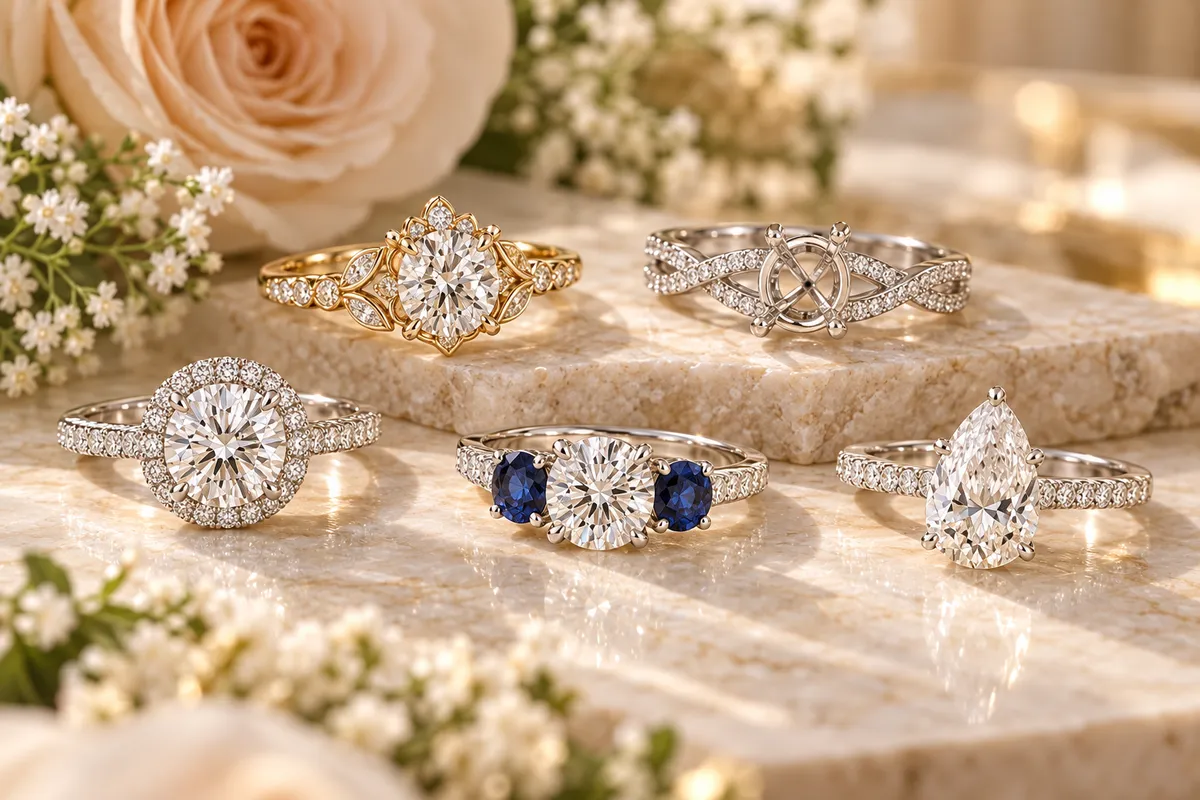
Unique engagement rings mean a longer search, a bigger budget, or a designer in another state, or so most brides assume. That is not true. It is often just a matter of knowing which details to change first: the stone, the metal, or the setting.
In Orange, CT, you can see these options in person instead of guessing from a product photo. A setting looks different under a jeweler's light than it does on a phone screen, and a stone's color can shift depending on what it sits next to. Stone choice, metal choice, and a fully custom build are the three levers that change a ring's personality the most.
Unique engagement rings: styles for every personality
A ring starts to feel unique the moment it stops looking like everyone else's solitaire. Small changes to the setting, the band, or the stone shape go a long way, and none of them require starting from a blank page. Vintage, minimalist, and nature-inspired are the three engagement ring styles we get asked to recreate most often.
Vintage-inspired details
Milgrain edging, filigree scrollwork, and halo settings borrow from Edwardian and Art Deco design. These details catch light differently than a plain band, which is part of why they photograph so well.
Minimalist & modern
A thin band with a low-profile bezel setting keeps the focus entirely on the stone. This style works well for anyone who wears rings daily for work, since there is less metal to catch on gloves or fabric.
Nature-inspired
Leaf motifs, branch-textured bands, and asymmetrical clusters take their cues from the outdoors rather than geometric tradition.
Vintage-inspired details
Milgrain edging, filigree scrollwork, and halo settings borrow from Edwardian and Art Deco design. These details catch light differently than a plain band, which is part of why they photograph so well. A vintage-inspired setting also pairs naturally with a matching band from our wedding ring sets collection, so the two pieces read as one design instead of two separate purchases.
Older cuts like the old European or cushion cut show up often in this category too. Both cuts have softer, less angular facets than a modern round brilliant, which gives them a warmer sparkle under indoor light. A jeweler can reset a family stone into a new vintage-style setting, which keeps the sentimental value while updating the overall look.
Minimalist and modern settings
At the other end, a thin band with a low-profile bezel setting keeps the focus entirely on the stone. This style works well for anyone who wears rings daily for work, since there is less metal to catch on gloves or fabric.
A hidden halo, where a ring of small stones sits underneath the center stone rather than around it, is a popular way to add sparkle without changing the ring's clean silhouette from the top. Tension settings, which hold the stone between two ends of the band with no visible prongs, are another modern option worth trying on before you decide against it.
Nature-inspired and organic shapes
Leaf motifs, branch-textured bands, and asymmetrical clusters take their cues from the outdoors rather than geometric tradition. These settings tend to read as more casual, which makes them a strong fit for a couple who wants a ring that does not look overly formal day to day.
Textured or hammered metal finishes often show up alongside these shapes, since a matte or brushed surface suits an organic design better than a high-polish shine. If you spend time outdoors, this category is worth trying on first, since photos rarely capture how the texture catches natural light.
Colored gemstones and custom details that make a ring yours
Sapphires, emeralds, and other colored stones
Sapphires, emeralds, morganite, and spinel are the four colored stones we get asked about most often. Each one carries its own durability profile, which matters for a ring worn every day. Sapphires rank just below diamonds on the hardness scale, making them a practical daily-wear choice, while emeralds need a protective setting because they chip more easily. You can browse our gemstone rings collection to see how each stone looks set in different metals before deciding.
The American Gem Trade Association publishes grading standards for colored stones that go beyond the four Cs used for diamonds, covering saturation, hue, and treatment disclosure. Ask any jeweler whether a colored stone has been heat-treated or clarity-enhanced, since both are common and acceptable practices but affect long-term care and resale value. Morganite and spinel run softer than sapphire, so they suit a ring worn on weekends more than one worn during manual work.
Fully custom, built from scratch
If nothing in a case matches what you have in mind, a fully custom ring starts with a sketch or a reference photo instead of an existing design. Our jewelers work directly with you on stone selection, setting style, and sizing, and because we source diamonds directly from Antwerp, custom stones often cost less than they would through a big-box retailer.
A typical custom build moves from an initial sketch to a wax or CAD model you can review before anything is cast, so changes happen before metal is committed rather than after. Most custom pieces take a few weeks from final approval to pickup, though a rush timeline is sometimes possible for a specific date. Engraving inside the band, whether a date, initials, or a short phrase, is usually added at no extra design step once the ring itself is finished.
Gold, platinum, and mixed metal options
Metal choice affects both the look of a ring and how much upkeep it needs over the years.
Yellow gold and rose gold warmth
Gold engagement rings have come back strongly over the past several years, especially yellow gold paired with colored stones or vintage-style settings. Rose gold reads slightly warmer and tends to flatter a wider range of skin tones, which is part of why it has stayed popular for the same stretch of time.
Both metals are usually sold in 14k or 18k purity for engagement rings. 14k gold holds up better against daily scratches because it contains more alloy metal, while 18k has a richer color but scratches somewhat more easily.
Platinum and white gold durability
Platinum does not need replating and holds up well against daily scratches, though it costs more upfront than white gold. White gold looks nearly identical to platinum when new, but its rhodium plating wears down over years of wear and needs to be reapplied periodically.
Rhodium replating is a routine service, usually done in under an hour, and most jewelers recommend it every 12 to 18 months for a ring worn daily. If you would rather skip that maintenance step entirely, platinum is the better long-term choice even though the sticker price is higher.
Mixing metals for a two-tone look
A two-tone setting, such as a platinum head on a yellow gold band, lets a ring coordinate with jewelry in either metal. This is a practical choice for anyone who already owns and wears pieces in more than one metal color.
Two-tone settings also make a ring easier to match later, since a wedding band in either gold or platinum will sit comfortably alongside it. This is worth considering early if you already know you want mismatched metals in your everyday jewelry.
Why working with a local jeweler matters for a unique design
A unique design lives or dies on the details you cannot see in a photo: how a stone is cut, how a setting is finished, whether a claim about clarity or origin actually holds up. The Gemological Institute of America, or GIA, sets the grading standards most independent jewelers rely on for exactly this reason, and our team holds GIA-aligned training for that same standard of accuracy on every one of our unique engagement rings. When you design in person, you can compare stones side by side under the same lighting instead of relying on a product photo edited for a website. That difference matters most on a piece you will wear every day for decades.
A local jeweler can also handle appraisals and insurance documentation as part of the same visit, since a custom or one-of-a-kind piece needs its own written appraisal rather than a generic receipt. This matters more for a design with a colored stone or a family heirloom reset into it, where a standard insurance policy may not reflect the piece's actual value without that documentation. Our team has offered appraisal and insurance support alongside design work for three generations, which means the person building your ring is often the same person who can answer questions about it years later.
How to choose your own unique engagement ring idea
Start with the one detail you keep coming back to, whether that is a colored stone, a particular metal, or a setting style you have saved from somewhere else. Everything else in the design should support that one choice rather than compete with it.
Set a budget range before your first appointment rather than during it. A jeweler can then narrow suggestions to stones and settings that actually fit, instead of showing you options across the full price range and letting you eliminate them one by one.
Bring reference photos even if none of them match exactly. A jeweler can pull the setting from one photo, the stone shape from another, and combine them into something that did not exist in either original image.
Brides from Shelton and New Haven often come in with a Pinterest board and leave with something closer to what they actually pictured, because trying on a setting under real light changes how a design reads. Around the winter holidays, when a large share of Fairfield County engagements happen, our Orange, CT showroom gets busy with exactly this kind of appointment. If you are searching for unique engagement rings near me rather than shopping online only, that in-person comparison is the actual advantage, not just a nice extra.
Frequently asked questions
Where can I buy unique engagement rings?
Independent jewelers, custom studios, and estate dealers typically carry more distinctive styles than mall chains. Cellini Design Jewelers in Orange, CT stocks curated designs and builds fully custom pieces on site, so you can compare both options in one visit.
How do I make an engagement ring unique?
Change one element at a time: swap the center stone for a colored gem, add vintage detailing like milgrain edging, or mix two metal tones. A jeweler can show you these changes on the same base setting so you see the effect before committing.
What makes an engagement ring design unique?
A combination of an uncommon stone, a nontraditional setting style, or personal details like engraving or a family stone reset into a new design makes a ring feel unique. It is rarely just one feature. Most distinctive rings combine two or three smaller choices.
How do I find a unique engagement ring that fits my budget?
Start with the stone type rather than the setting, since colored gemstones and lab-grown diamonds cost less than natural mined diamonds at the same size. From there, a jeweler can recommend settings that fit both the stone and your price range.
Find a ring that feels like yours
Ready to see these options in person rather than choose from photos alone? Book a design consultation with our team and bring any reference photos, Pinterest boards, or family stones you want us to work from.
We work with couples across Orange, Shelton, New Haven, and Norwalk on both curated and fully custom unique engagement rings.
Start Your Custom Ring Design